YOUR CART
- No products in the cart.
Subtotal:
$0.00
Schabmüller Automobiltechnik is a leading engineering, machining, and sub-assembly supplier to major automotive OEMs and Tier 1 suppliers. Founded in 1978, the company’s headquarters is in Großmehring Germany, and employs 850 people in four locations.
Manufacturing castings with the lost foam process enables the foundry to produce castings with many benefits and features not available in other casting processes. This casting process is advantageous for very complex castings that would regularly require cores. It is also dimensionally accurate, maintains an excellent surface finish, requires no draft, and has not parting lines so no flash is formed.

Like all casting processes, lost foam castings may exhibit unwanted shrink porosity in the final product. The lost foam casting shrink porosity is due to the dispersal of the gas from the destruction of the foam cores during the casting process. Many lost foam castings exhibit leaks that prevent the castings from functioning properly. The leaks keep gases and fluids from properly flowing through the casting when under pressure.
With the launch of a new family of three engines using lost foam castings for both cylinder heads and blocks, an OEM began to evaluate the effectiveness of different vacuum impregnation processes. After carefully evaluating results from different vacuum impregnation processes, it was specified that all lost foam should be processed through a Dry Vacuum and Pressure (DVP) process. The plan required 100% impregnation of both the block & head and even with the superior results delivered by the DVP process the OEM needed to ensure the absolute highest seal rates.
Godfrey & Wing had been working on a new revolutionary approach to vacuum impregnation- Continuous Flow Impregnation (CFi). Ideally, designed and suited for powertrain manufacturing, the new system would:
Working with the OEM, Godfrey & Wing initially launched the new CFi process on lost foam cylinder heads. The results were exceptional and the program was expanded to cylinder blocks as new equipment was designed and built.
The OEM and Godfrey & Wing conducted a massive Production Trial Run (PTR), studying the results on over 450,000 cylinder block castings. Castings were impregnated on Godfrey & Wing’s CFi and batch system, as well as the batch systems of three other vendors. The data in figure 1 shows that the Godfrey & Wing CFi technology surpassed all other traditional batch systems used to impregnate lost foam castings.
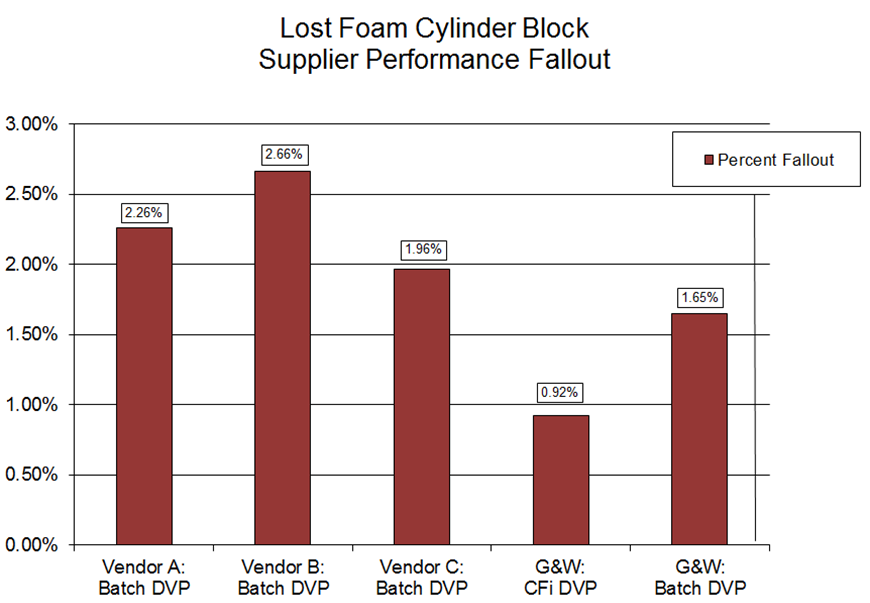
Figure 1
With years of experience with the impregnation of lost foam castings, Godfrey & Wing has developed processes and systems targeted to meet the unique requirements of lost foam castings.
Godfrey & Wing has impregnated millions of lost foam castings. Through continuous effort to achieve better results, Godfrey & Wing has been able to reduce the fall-out at final test for LF components for major powertrain programs. Godfrey & Wing approach to systems, like the CFi, have also reduced the risk of non-conforming parts entering the production flow. Godfrey & Wing systems are shipped worldwide to enable our customers to recover more castings and use less resources and overhead than any other vacuum impregnation system in the world.
The Albert Handtmann Metallgusswerk GmbH is the largest lightweight (aluminum) foundry in Germany. The family-owned company has continually endeavored to improve its casting and machining processes to benefit its customers worldwide.
Thus, when Daimler AG awarded Handtmann a contract to cast and machine one third of the entire worldwide production of transmission cases and clutch housings for the Mercedes A-Class, B-Class, CLA-Class, and GLA-Class vehicles, the managing directors and board at Handtmann saw an opportunity. It was an opportunity to build a world-class production facility fully dedicated to automated one-piece flow in the complete machining and post-machining processes of these Mercedes cases and housings.
As a company, Handtmann was expert in almost all of the production processes required as part of this new facility. However, in order to achieve true one-piece flow, Handtmann had to bring inside a critical aspect of quality control that the company had previously hired out, vacuum impregnation.
In the past after machining, Handtmann had always sent out its transmission cases and clutch housings to vendors to be vacuum impregnated. The company’s experience here was not always pleasant. At external points parts have been damaged during transport or contaminated. To avoid additional handling and costly washing-process, they decided to integrate this process into the (manufacturing) line.
For Handtmann, the challenge was to quickly educate its executives on the detailed aspects of vacuum impregnation, then chose the proper vacuum impregnation equipment to install. This equipment would have to meet Handtmann’s demands to seal casting porosity effectively and to meet production volumes, to do so in a 96-second per piece TAKT time, to fit into a confined space on the facility’s floor, and to fully integrate within the automated processes that would govern the entirety of the plant.
Since several of Handtmann’s vacuum impregnation service providers also build impregnation equipment, the company began by soliciting bids from these traditional sources. However, it was apparent immediately on receipt of these bids that the equipment proposed could not possibly be installed as part of a one-piece flow manufacturing line. The big batch systems that were recommended require parts to be manually loaded and unloaded and they carry a high risk for damage and contamination to the machined parts. They require significantly more TAKT time to complete the impregnation process. They also require a tremendous amount of floor space, for both the equipment itself as well as for loading and unloading areas. Hence, the big batch systems proposed early on were completely disqualified. Handtmann needed more advanced technology. Enter Godfrey & Wing.
By chance, a Handtmann engineering executive came across an article about a different process of vacuum impregnation called Continuous Flow Impregnation written by Ralf Versmold, Godfrey & Wing’s sales and service director for Europe based in Germany. As the name itself indicates, Continuous Flow technology was developed by Godfrey & Wing to answer the demand for the vacuum impregnation process to be fast, efficient, and capable of being installed as part of a machining line where floor space is limited.
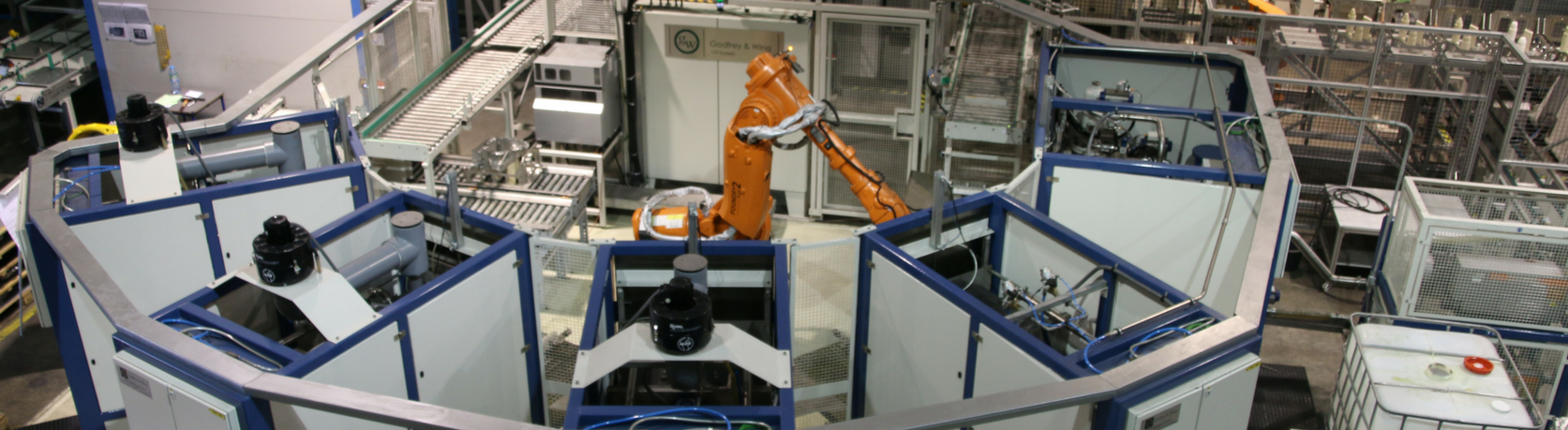
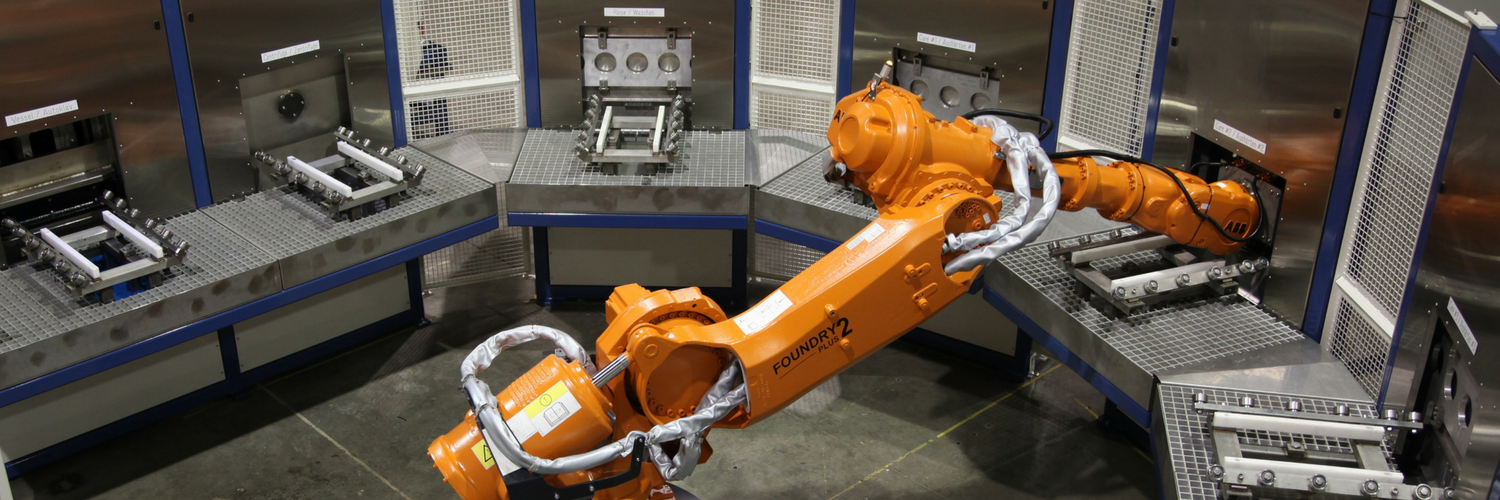
After visiting several CFi installations in 2012 and learning firsthand from Godfrey & Wing customers about the effectiveness and efficiency of these CFi systems, Handtmann purchased a multi-station CFi from Godfrey & Wing in early 2013. The system was installed in Handtmann’s new Mercedes one-piece flow manufacturing facility in Biberach, Germany in late 2013 where it operates alongside machining centers, parts cleaning equipment, and pressure test benches in a fully automated environment. This CFi includes a compact impregnation pressure vessel, a high-speed centrifuge, a wash tank, and three cure stations, all serviced by a robotic arm and automated conveyors. Six days per week, 24 hours per day, this CFi vacuum impregnates every transmission case and clutch housing that fails its initial pressure test.
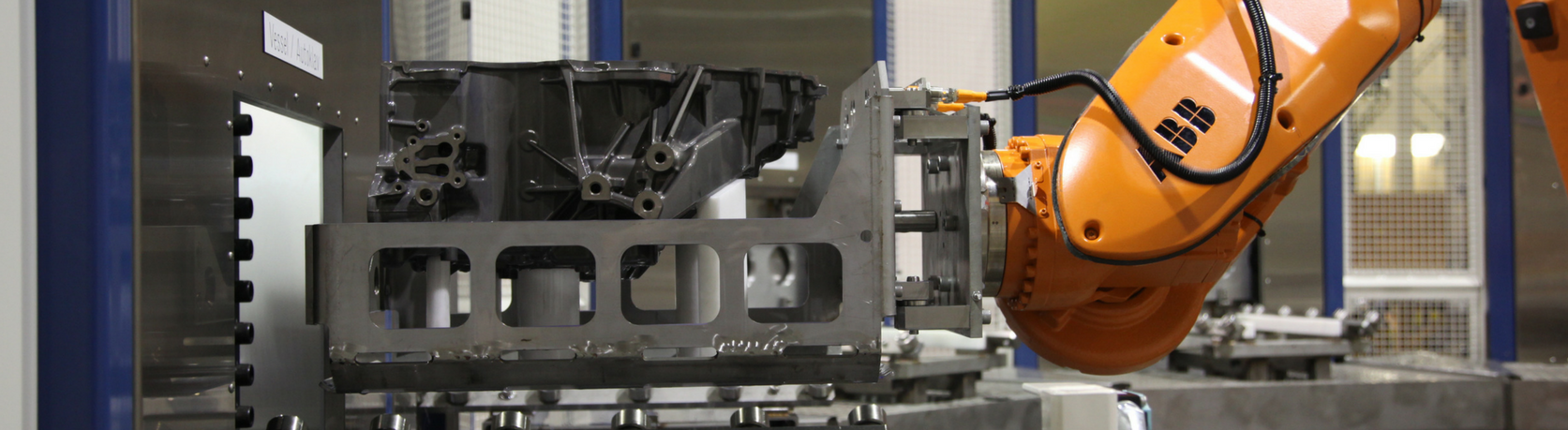
Considering the four demands required of it– speed, efficiency, and total automation within a small footprint, Godfrey & Wing’s Continuous Flow Impregnation system has proved to be the perfect solution for Handtmann Metallgusswerk in its dedicated Mercedes machining facility. Today, this CFi plays an integral role in the manufacture of these transmission cases and clutch housings and it does so in one of the most advanced manufacturing facilities in the world.
Production manager Heiko Pfeiffer sees a huge cost/handling and thus competitive advantage due to the direct automatic integration of the CFi-technology. He confirms, that the CFi-technology is actually the only possibility to integrate the impregnation-process into the manufacturing-process within a modern production-environment.
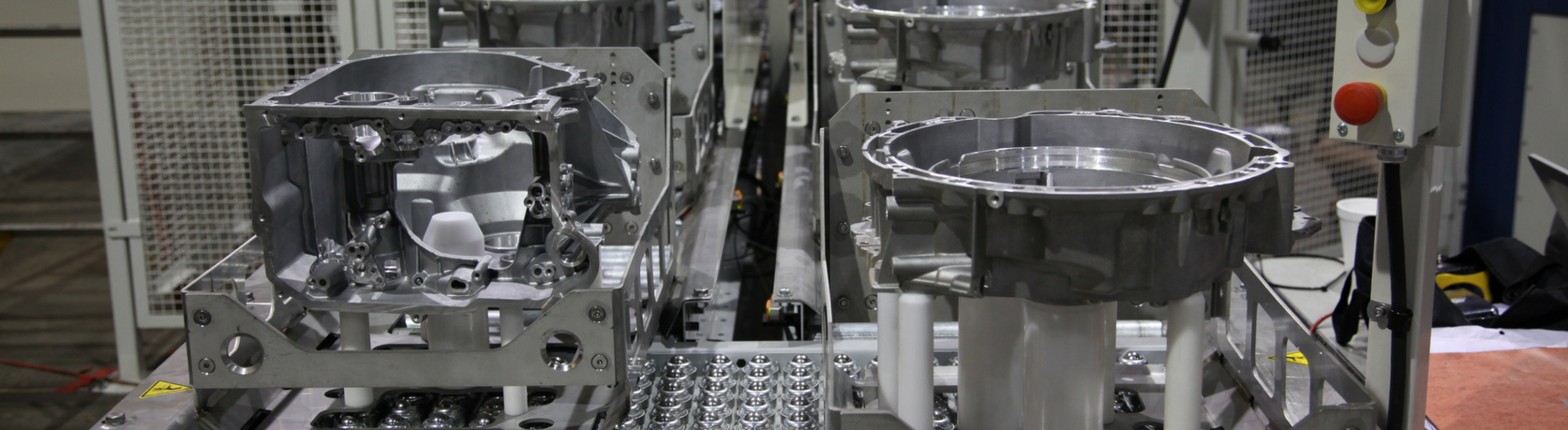
Foundry Management & Technology recently wrote an article about a Godfrey & Wing HVLV vacuum impregnation system that was installed at SEW-Eurodrive. You can read the entire article below.
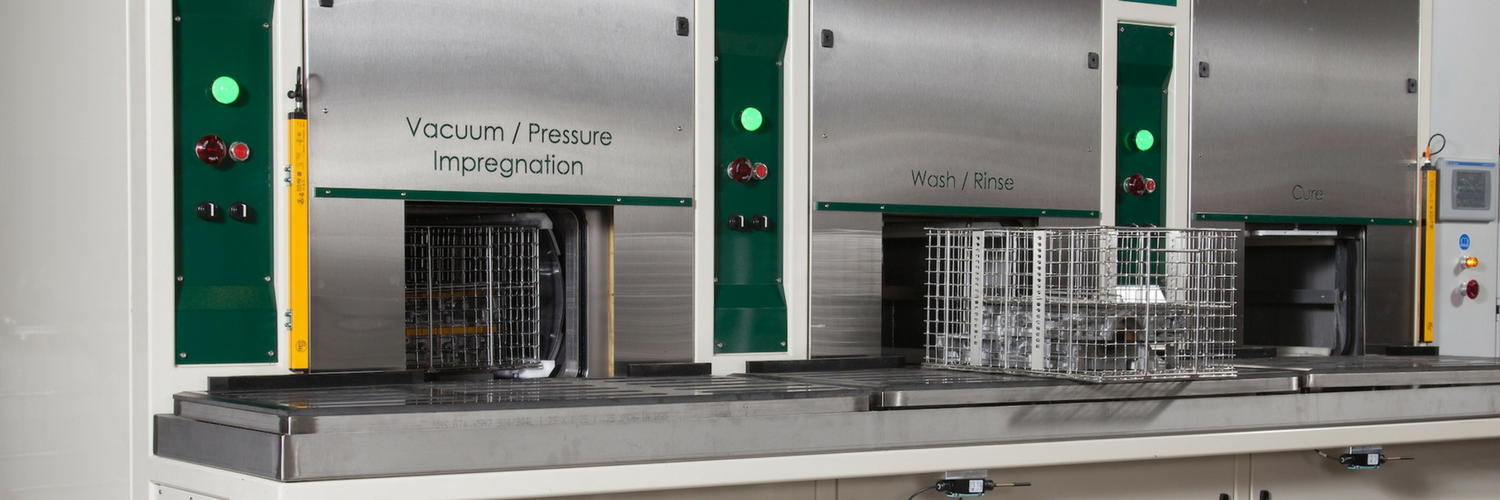
Sealing equipment specialist Godfrey & Wing has a contract to supply its HVLV vacuum-impregnation system to SEW-Eurodrive, to seal diecast aluminum motor and gear components at its operation in Fordach, France. SEW is a developer and manufacturer of decentralized motor control technology. It also produces large industrial gearboxes, with helical, bevel helical, and planetary gears.
The system will be installed next year. According to Godfrey & Wing, the order also includes its 95-1000AA recoverable sealant and ongoing techni cal support.
Also, according to G&W, the contract resulted from SEW-Eurodrive’s plan to move its vacuum impregnation processes in-house. In-house production will reduce freight costs and production delays that necessitated by outsourcing the part-sealing stage of production.
Godfrey & Wing has published an article in LightWeighting World titled “Vacuum Impregnation Enables Lightweight Material Use”. This article discusses the surge in aluminum use and how vacuum impregnation eliminates aluminum casting porosity. You can read the entire article below.
Recent decades have seen a surge in use of aluminum castings in car manufacturing. Aluminum has been a key material in car manufacturing since the beginning. The first sports car featuring an aluminum body was unveiled at the Berlin International Motor Show in 1899. Carl Benz developed the first engine with aluminum parts two years later1. Since this time, aluminum has become the leading material used in various components and car models. Aluminum use now ranges from mass-market to luxury vehicles.
As this surge has happened, vacuum impregnation has become the primary method to eliminate the porosity inherent in aluminum castings. OEMs are redesigning parts and bringing vacuum impregnation systems in-house to meet the aluminum use demand.
A question that is often asked is “Will the sealant used in vacuum impregnation melt?” This is asked by those who’s castings need to withstand heat. In this blog, we will answer this question.
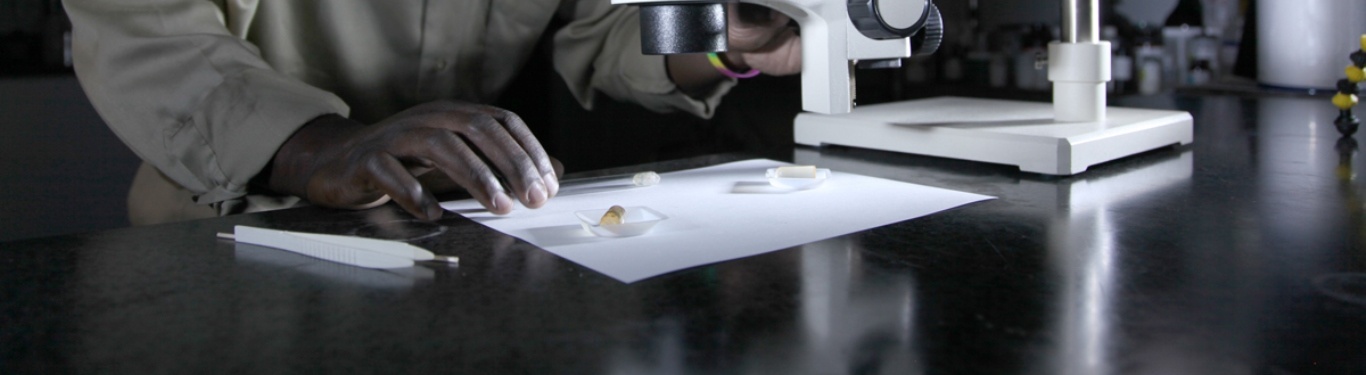
The short answer is no, Godfrey & Wing sealants do not melt under standard operating temperatures. Impregnation sealants are based on polymethacrylate plastics. There are two types of polymethacrylates: thermoplastic and thermoset.
A thermoplastic is a polymer that softens on heating and hardens on cooling. Common thermoplastics are polyethylene and polystyrene.
A thermoset is a durable plastic that once formed or molded, retains its form and shape even if heated or subjected to various solvents. Vacuum impregnation sealants are thermoset.
These two types of plastic are both called polymers. Polymers (“poly” = many from Greek) are very large molecules comprised of smaller molecules called monomers (“mono” = one). Most polymers consist of monomers that are similar to each other, joined together in a straight chain, like a strand of spaghetti. However, chemists have learned to link these chains together, called “crosslinking”. Chemists crosslink thermosets in a 3D network to prevent them coming apart when heated or exposed to aggressive liquids.
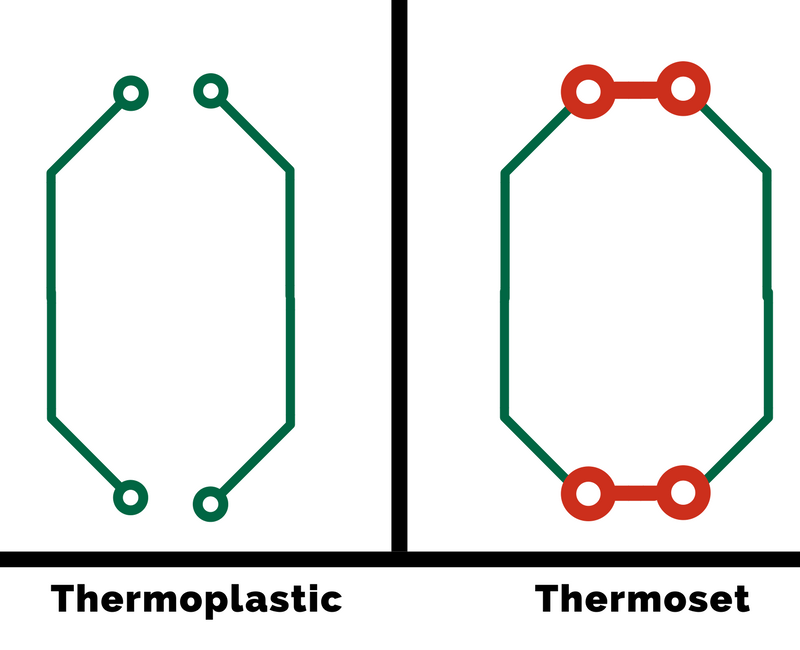
Looking at the pictures above, a simple way of understanding this is to imagine a thermoplastic polymer is like a bowl of spaghetti. If you are really careful, then you could separate all the individual strands or chains. This is what happens when a thermoplastic is heated –the chains separate and flow. In the thermoset example, this is impossible.
The crosslinked methacrylate polymers used in impregnation sealants can often withstand temperatures over 392 °F (200 °C). The sealants can also withstand aggressive fluids such as hot automotive fluids without degradation. As a result, vacuum impregnation is the preferred method to seal casting porosity. It is the simple and permanent solution to porosity.
Vacuum impregnation in metal castings and powdered metal parts refers to the sealing of leaks resulting from porosity. In this post, we will discuss in detail one of the selection variables, the three different types of vacuum impregnation processes.
Godfrey & Wing has published an article in Foundry Management & Technology titled “Continuing Advances in Vacuum Impregnation Systems”. This article discusses the manufacturing safety and manufacturing production advancements in vacuum impregnation equipment. You can read the entire article below.
Godfrey & Wing’s vacuum impregnation equipment is the best in the world. The equipment re-imagined vacuum impregnation by making it safer, increasing production and eliminating casting defects. But how exactly does it work? Watch this animation video.
Vacuum impregnation seals porosity and leak paths in metal castings and powdered metal parts that form during the casting or molding process. The process is done by filling the pores with a sealant under pressure to stop fluids or gases from leaking under pressure. Vacuum impregnation stops casting porosity and allows manufacturers to use parts that would otherwise be scrapped.