YOUR CART
- No products in the cart.
Subtotal:
$0.00
Our new Advanced Powertrain impregnation (APi) system simplifies and compacts the vacuum impregnation process so that you can bring vacuum impregnation equipment in house. The APi takes our patented front loading technology and increases the impregnation chamber for large parts-like engine blocks or powertrain transmission cases. (more…)
Years ago and even today, Batch System Vacuum Impregnation was the most common vacuum impregnation system. Despite a recent shift towards Single Piece Part Flow (i.e. HVLV, CFI, APi, and EcoSeal), there is still value in Batch System Vacuum Impregnation. Bottom line, the advantages of this process is that it is the best solution to provide capacity-multiple amounts of product can be serviced in one cycle.
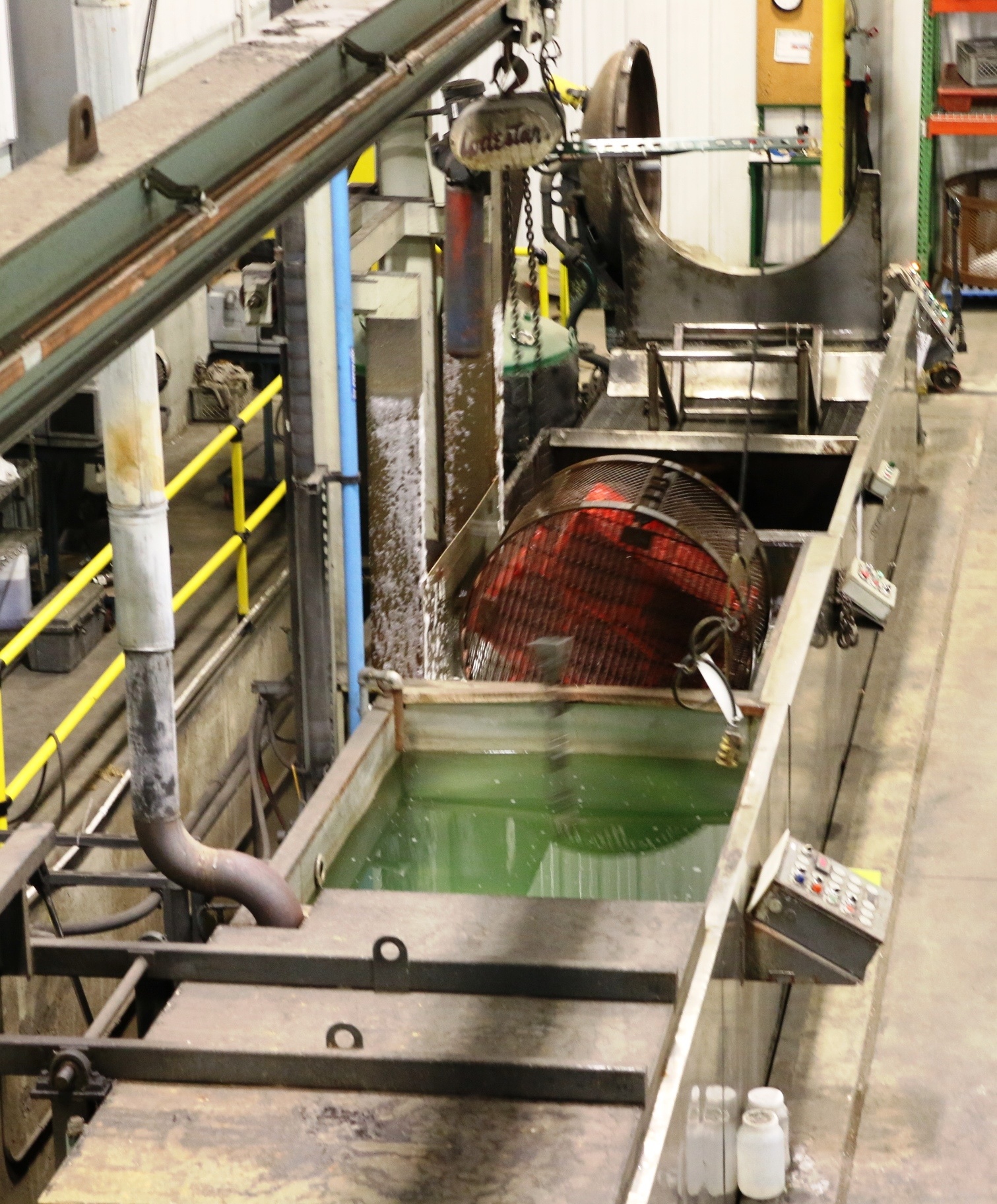
Both batch and single piece part flow impregnation systems accomplish the same 4 basic tasks:
So if all impregnation systems accomplish the same tasks, then how does a batch system work differently?
It’s simple; a Batch system is compiled of a large vessel, large tanks and large baskets.
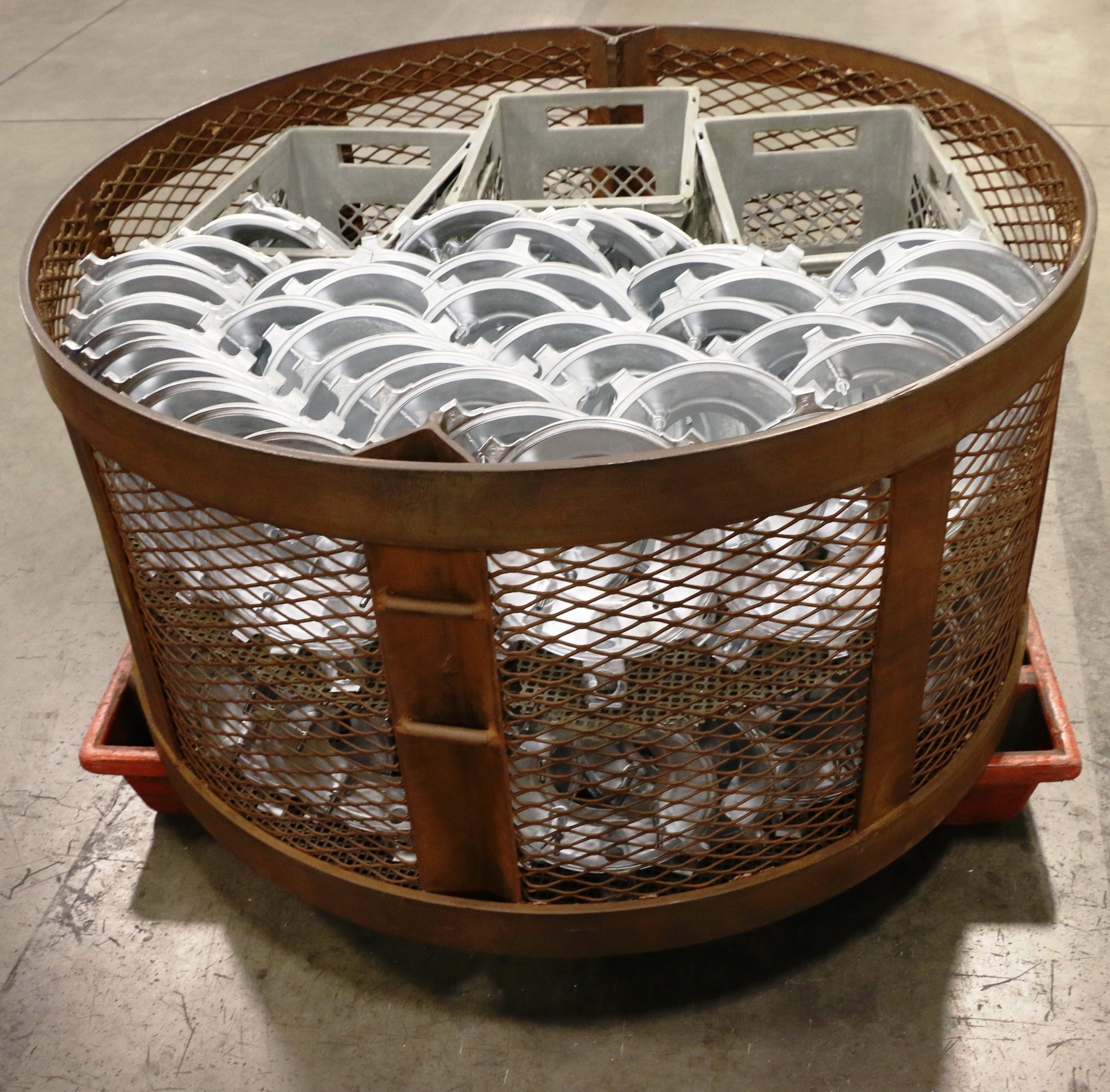
Multiple castings are placed in baskets, which then are put through the impregnation process, first the vessel, then the wash and finally the cure.
So when should a Batch system used? The system should be utilized when:
This condensed overview will provide you a better understanding on the benefits of a Batch system. Of course, this system is not a “one size fits all” for vacuum impregnation needs. At Godfrey & Wing, we manufacture and utilize both batch and single piece part flow. Both systems have benefits to different needs.
We are sometimes told by customers that they are unaware of what vacuum impregnation is. Ultimately, they have a casting with porosity that is leaking whatever is passing through the part (i.e. air, gas, water, etc.), and they need a solution to their problem. Here are some of the more common questions that we receive in regards to vacuum impregnation and porosity. Our intent is that you can use this information as a guide when you need to correct castings with porosity.
Would you like this information in a printable form? Of course! Click here to download it as a pdf.
What is porosity?
Porosity is an area of sponge-like texture in an otherwise sound metal casting. There are two types of porosity:
Porosity is typically caused during the casting process by internal shrinkage, gas cavitation, oxide films and inclusions and the many combinations thereof.
What is vacuum impregnation?
Vacuum impregnation (also known as “impregnation” and “impreg”) seals the porosity in metal castings, thus making leaky castings pressure tight.
What is the process of vacuum impregnation?
In a nutshell, the impregnation sealant is introduced into the voids within the wall thickness of the casting through vacuum and/or pressure methods. Subsequent processing solidifies the sealant.
What are the types of porosity?
There are three types of porosity:
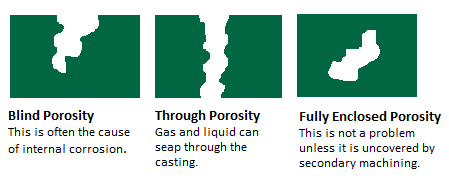
How does impregnation improve product quality?
When casting porosity is reviewed during inspection, “good” castings are as porous as the “bad” castings because the porosity is blind and not completely inter-connected. Subsequent mechanical or thermal shock or stress often breaks the thin membrane in the “good castings” which keeps the blind porosity from being continuous, thus causing a “leaker”. Impregnation fills porosity from both sides preventing leaks even if the membrane does break. Therefore, impregnation salvages castings and improves quality, while inspection only sorts out leakers.
What materials can be impregnated?
All ferrous and non-ferrous metals, whether sand cast, gravity die, pressure die castings or forgings can be impregnated to eliminate porosity. Iron, bronze, aluminum, zinc, magnesium, steel, sintered metals and plastics, as well as alloys of these metals can be impregnated.
Can cracked castings be fixed through impregnation?
No. Impregnation will not increase the strength of a casting. The cracks will reopen when the casting is under pressure.
Can vacuum impregnation cure surface flaws?
No. This is because impregnation is within the part and not a surface treatment.
Should impregnation occur before or after machining?
Impregnation occurs after a casting is machined. This is because machining may potentially uncover additional porosity.
Will impregnation discolor or damage the casting?
No, because impregnation occurs within the walls of the casting. There is no film or coating on the part surface that will change any dimensional tolerances.
These are not the only questions we receive in regards to vacuum impregnation and porosity.
To discuss your specific questions, or situation, contact us at 330-562-1440 or send us an email.
Next Steps
The Albert Handtmann Metallgusswerk GmbH is the largest lightweight (aluminum) foundry in Germany. When the opportunity arose for the company to cast and machine one third of the entire world production of transmission cases and clutch housings for Mercedes Benz, not just any vacuum impregnation system would work.
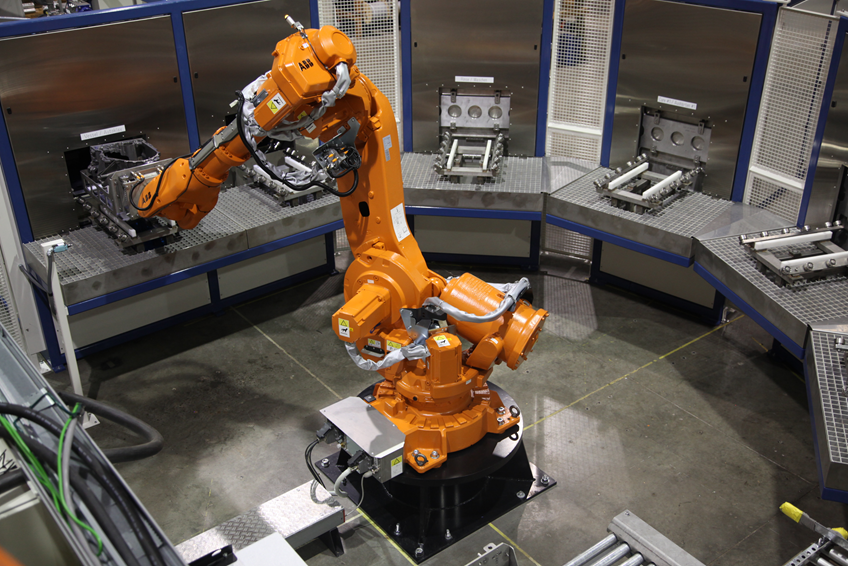
They needed a vacuum impregnation system to meet:
-Stringent Quality Standards
-High Production Volumes
-Meet a Tight Cycle Time
-Fit in a Confined Space
To learn how Godfrey & Wing played an integral role in Handtmann’s manufacturing process,
click here to read the entire case study.
Our new Mexico vacuum impregnation plant is featured on the cover of the Fundidores April addition.
If you have not read the recent Fundidores from Metal Spain, then click here to download your free copy. FYI, the magazine is both in Spanish and English. The Englsih version begins on page 28.
Our Mexico service center opened towards the beginning of this year and is located in Santa Catarina, part of the Monterrey Metropolitan Area in the state of Nuevo Leon.
This new facility comprises 10,000 square feet and houses the HVLV, GW’s groundbreaking impregnation system that uses a patented single piece flow Dry Vacuum and Positive Pressure (DVP) process. Click here to learn more about our Mexico location.
For more information about Godfrey & Wing, please contact us by email or call +1.330.562.1440.

As we begin a New Year, we want to share our top 3 most read blog posts of 2014. If you missed any of these articles, be sure to check them out. They include helpful information about continuous flow vacuum impregnation, the quality of an impregnation process and sealants.
As we approach a shutdown used by many manufacturers to service plant equipment, it is important to ensure that impregnation systems and sealants be included in the shutdown maintenance program.
The Continuous Flow Impregnation (CFi) System is a lean, front loading vacuum impregnation system that uses a robot for part handling and transfers between modules. This impregnation system has a cycle times of less than 95 seconds. Individual part handling leads to many process improvements, such as shorter cycle times, better rinse results without risk of contamination, damage or discoloration. Furthermore, each part passes through an identical process, and process parameters can be directly associated with a particular part (tracking).
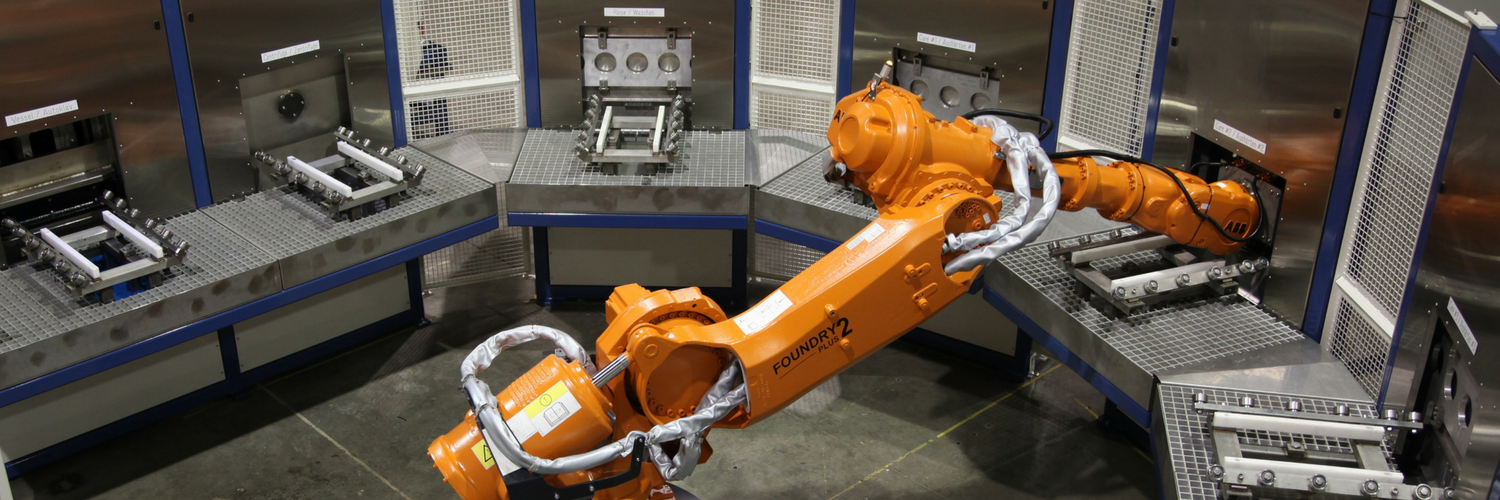
Continuous flow is the most recent technology in vacuum impregnation. Continuous flow vacuum impregnation systems are cellular or lean in design, focused on conserving valuable resources including labor, power and floor space while being more ergonomic than batch systems. The individual modules are loaded from the front, eliminating the need for overhead hoists and cranes. These systems impregnate smaller size batches or single components per impregnation cycle. This allows for reduction of individual module cycle times as well as increased mechanical manipulation assisting in the accomplishment of the four basic tasks of the impregnation process.
In general, lean, front loading continuous flow vacuum impregnation equipment uses smaller modules with little or no supporting infrastructure. Front loading systems can occupy as little as 86 ft2 of floor space and utilize conventional basket dimensions (e.g.: 600 x 450 x 350 mm), which can be adapted to meet specific part dimensions, if required.
Advantages of continuous flow vacuum impregnation systems:
Disadvantages of continuous flow vacuum impregnation systems:
The CFi technology is fully self-contained for quality with the robot and PLC working together to ensure that parts do not leave the cell if they have not met all of the pre-determined process parameters. Likewise, the use of robotics shortens cycle times, improving overall TAKT time and production volumes. At the same time robotic handling provides for repeatable processing while controlling handling damage.
The Continuous Flow Vacuum Impregnation technology offers manufacturers and OEMs the opportunity to completely integrate the impregnation process into their overall production line eliminating labor, reducing WIP and controlling costs. Existing cells deliver over 240,000 cycles per year operating 24/7. They are ideally suited for larger powertrain installations where uniformity and repeatability are essential to part quality and delivery is paramount. Higher volumes, expansion or ramping production can be met by integrating duplicate cells. The Continuous Flow Vacuum Impregnation technology enables continuous production through lean manufacturing.
| System | Workload Size | Process | Cycle Time | Use | Labor | Floor Space Requirement |
|---|---|---|---|---|---|---|
| Top loading batch system | 24-96 inches in diameter; working depths of 12-120 inches | DVP, DV or W | 20-40 minutes | Jobbing and processing hundreds of unique parts, large and small | High | 1.000 to 10.000 square feet, including storage and support equipment |
| Front loading system | Rectangular tote size of 300 mm x 400 mm x 800 mm | DVP or DV | 240-540 seconds | Specialized, similar parts, large and small | Low | Low |
| Continuous flow system | Rectangular tote size of 300 mm x 400 mm x 800 mm or direct part handling | DVP or DV | 90 seconds | Specialized, similar parts, large and small | Low to None | Low - less than 600 square feet |
MIL-I-17563C is the Military Specification for cast or powder metal components. This specification is approved for use by all Departments and Agencies of the Department of Defense and “covers the requirements for impregnants suitable for use in sealing the voids found in cast or powder metal components which cause leaking of contained fluids.”
To answer the question above, it’s important to first understand the 3 classifications within MIL-I-17563C.
Class 1 – Suitable for service temperatures up to 300°F (149°C)
Class 1a – Suitable for use on mortar shell castings up to 300°F (149°C)
Class 2 – Suitable for service temperatures up to 500°F (260°C)
Class 3 – Suitable for use where air pollution requirements apply and compatible with acrylic-nitrocellulose lacquer paint system up to 300°F (149°C)
In general, all organic based vacuum impregnation sealants are qualified to Class 1 and 3. Class 2 was designed specifically for sodium silicate which is in very limited use today, and Class 1a qualifies the sealant to be compatible with TNT (Trinitrotoluene) and Composition B explosives.
To qualify for MIL-I-17563C, the sealant is subjected to various tests including pot and storage life stability. Once activated, the sealant must be stable at 75 +/- 5°F (24 +/- 2.8°C) for one month for thermal cure and 45 +/- 5°F (8 +/- 2.8°C) for anaerobic while under aeration. Un-activated or un-catalyzed material in an unopened container must meet the manufacturer’s original specification at the end of one year from date of manufacture. All Godfrey & Wing sealants are approved for two (2) years.
The sealant reactivity to various metals including aluminum, copper, iron, magnesium and zinc is also tested. Samples must not exhibit any obvious surface defect such as holes, pits and fissures. Samples with copper shall not show a greenish coloration after exposure for 24 hours.
Godfrey & Wing currently has five sealants approved on QPL-17563 and are listed below:
95-1000 – Thermal curing
95-1000A – Thermal curing
95-1000AA – Thermal curing
95-1000AC – Anaerobic
95-1000ACP – Anaerobic
Conditioning testing under various test media, time and temperature are shown in Table 1.
TABLE 1 – Conditioning Tests
| Impregnation Class | Material | Media Specifications | Time | Temperature |
|---|---|---|---|---|
| 1 and 3 | Carbon Removal | P-C-111 | 30 minutes | 73.4 +/- 3.6 °F (23 +/- 2 °C) |
| 18% Sulfuric Acid | O-S-809 | 2 hours | 73.4 +/- 3.6 °F (23 +/- 2 °C) | |
| Turbine Fuel | MIL-T-5624 | 48 hours | 73.4 +/- 3.6 °F (23 +/- 2 °C) | |
| Fuel | ASTM D-910 | 48 hours | 73.4 +/- 3.6 °F (23 +/- 2 °C) | |
| Diester Grease | MIL-G-23827 | 48 hours | 73.4 +/- 3.6 °F (23 +/- 2 °C) | |
| Stoddard Solvent | P-D-680 | 48 hours | 73.4 +/- 3.6 °F (23 +/- 2 °C) | |
| Ethyl Alcohol | MIL-E-463 | 48 hours | 73.4 +/- 3.6 °F (23 +/- 2 °C) | |
| Hydrocarbon Fluid | TT-S-735 | 14 days | 73.4 +/- 3.6 °F (23 +/- 2 °C) | |
| Water | N/A | 14 days | 212 °F (100 °C) | |
| Oil | MIL-H-17672 | 14 days | 210 +/- 5 °F (99 +/- 2.8 °C) | |
| Hydraulic Fluid | MIL-F-17111 | 14 days | 210 +/- 5 °F (99 +/- 2.8 °C) | |
| Lubricating Oil | MIL-L-7808 | 48 hours | 255 +/- 5 °F (121 +/- 2.8 °C) | |
| Ethylene Glycol | MIL-E-9500 | 14 days | 300 +/- 5 °F (149 +/- 2.8 °C) | |
| Ethylene Glycol | MIL-E-9500 | 14 days | 397 +/- 5 °F (197 +/- 2.8 °C) | |
| Thermal Resistance | N/A | 14 days | 300 +/- 5 °F (149 +/- 2.8 °C) |
As we begin a New Year, we want to share our top 5 blog posts of 2013. If you missed any of these articles, be sure to check them out. They include helpful information about vacuum impregnation economics, processes and sealant.
How Much Does it Cost to Impregnate a Part?
Or in other words, how much sealant will a part consume? Parts consume sealant in two ways as part of the normal vacuum impregnation cycle.
Types of Vacuum Impregnation Processes
There are a variety of factors that can help you determine which type of vacuum impregnation system will best meet your needs, including processes, systems and sealants.
What Vacuum Impregnation Is Not
When thinking about vacuum impregnation it’s important to remember a few things that the process does not do.
Vacuum Impregnation Economics
If the impregnation process is not efficient and fails to seal the casting it will become scrap, and the number and value of these failures will determine the economic viability of the process.
What Is the Sealant Consumption with Godfrey & Wing Sealants?
Some manufacturers state that sealant consumption is 10 grams per impregnated kilogram. Other manufacturers state 5 grams and some even say less than 2 grams. All of these numbers may be correct.
For more articles about vacuum impregnation, visit the Godfrey & Wing blog.