YOUR CART
- No products in the cart.
Subtotal:
$0.00
When it comes to vacuum impregnation, it’s essential to ensure that the parts being impregnated are dry beforehand. This is because any surface impurities can interfere with the impregnation process, leading to subpar results.
If any residual fluids or debris are on the parts prior to impregnation, then the following problems may occur.
OSHA issued a new regulation changing current Hazard Communication Standard (HCS) to conform to the Global Harmonized System of Classifying and Labeling Chemicals (GHS).
Under the GHS, material safety data sheets (MSDS) will now be called safety data sheets (SDS). SDS’s will provide you with procedures for handling and working with our sealants in a safe manner.
The SDS for our 8 sealants are available for download. You can receive these documents by clicking on the link below.
In an earlier blog article, we discussed the most common ways that sealant can get into vacuum pumps during the impregnation process.As a reminder, the list included:
The next step is to discuss how to defend against the problem of sealant getting into vacuum pumps. Even if an impregnation system is properly set up and maintained, accidents can happen that can lead to this problem. The best defense is a trap that the sealant can be “caught” in prior to reaching the pump.
Depending on the level of protection desired, traps can be as simple as a loop in the vacuum hose/line or as sophisticated as a mechanical trap with sensors.These traps are located between the impregnation vessel and the vacuum pump.The purpose of a trap is to give the sealant an alternative place to go (get trapped) versus into the vacuum pump.
The simplest approach, which is effective when sealant rarely enters the vacuum pump, is to loop the vacuum hose/line in such a way that gravity alone stops sealant before the pump.In this case, the weight of the sealant cannot overcome gravity and therefore cannot reach the peak of the vacuum hose, thereby “trapping” it in the line, typically to drain back into the vessel.
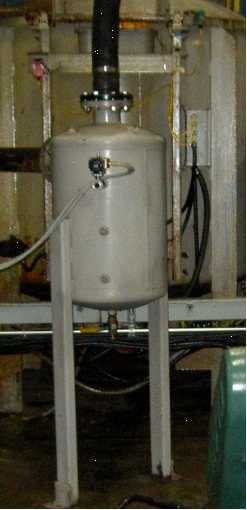
The next level of technology is a mechanical trap that is either maintained manually or set up for semi-automation (Fig 2 below). With these types of traps, there is a level sensor that sends a signal to the PLC, indicating that it is full and needs to be drained. A manual drain at the bottom allows maintenance personnel to easily drain the system.
The highest level of technology is a fully automated trap that allows for continuous running of the impregnation system (Fig 3 below). These traps also have level sensors to indicate when they are full. In addition, the traps are connected to pneumatic valves that are programmed to open between cycles, draining any sealant in the trap back into the sealant reservoir.
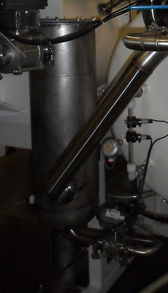
The interior of the mechanical traps can be of various design. Those requiring the least maintenance will have steel baffles that the air/sealant would have to navigate to get to the pump. Designed correctly, these are very effective and pulling any sealant out of the air flow.
Another option is to have filter elements (typically in the 5 micron range) that the air can pass through, yet the sealant will be trapped in.
Depending on the size and performance of the system, a cost-effective Vacuum Sealant Trap can be designed and installed. The additional protection for the vacuum pumps are worth the investment so as to reduce downtime and maintenance costs.
For more information on this topic, contact Godfrey & Wing.
In an aqueous environment small insoluble particles are kept in solution by physical forces. While temperature and velocity play important roles in solution stability, electrokinetic force is the biggest contributor. Most solids suspended in water possess negative charge. Because particles with similar charges repel each other, those particles with like charges choose to remain in suspension rather than clump together and settle out of suspension. Similarly, any circumstance that would result in reduced charges on the particles would allow them to gather into larger particles and eventually “floc”.
 The other morning I was walking the dog around 5:00 AM, and I noticed how exceptionally crisp and brilliant the stars were in the pre dawn sky, shining though the high pressure system overhead. While finishing the walk around the neighborhood, I thought about mankind’s worldview that the earth was flat as recent as 600 years ago and the reluctance of decision makers of that time, influenced by the rhetoric of naysayers, to accept anything other than the status quo.
A common problem for those operating impregnation systems is sealant making its way into a vacuum pump. Sealant inside a pump (Figure 1) will lead to increased maintenance costs; premature pump rebuilds; or early pump replacement resulting from irreparable pump damage. There are multiple ways sealant can end up in the pump.