YOUR CART
- No products in the cart.
Subtotal:
$0.00
The goal of a foundry is to produce high quality die castings that meet or exceed the customer’s specifications at a competitive cost. In some die casting cases, those specifications require that the part must hold pressurized fluid or gasses.
Companies use vacuum impregnation when the part must hold fluids or gasses under pressure. Vacuum impregnation is a proven process that seals internal porosity without impacting any other features of the manufactured part. A common question asked about vacuum impregnation is “Should vacuum impregnation be done before or after die casting machining?”
While some refer to porosity as a defect, it occurs naturally and is found in most materials, both man-made and in nature. In metal castings, porosity is typically considered any void found in the casting. Some metal casting porosity can affect the part’s structural integrity, creating a failure point. More commonly, porosity prevents the part from being pressure tight. This will impact performance if the part is designed to hold gases or fluids.
Casting porosity can be caused by gas formation or solidification while the metal is being moved from a liquid state to a solid state. This porosity can range in size, from sub-micron to voids greater than 10 mm, depending on the casting.
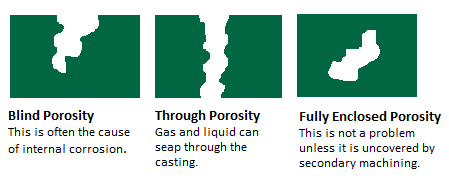
In general, there are three casting porosity classifications:
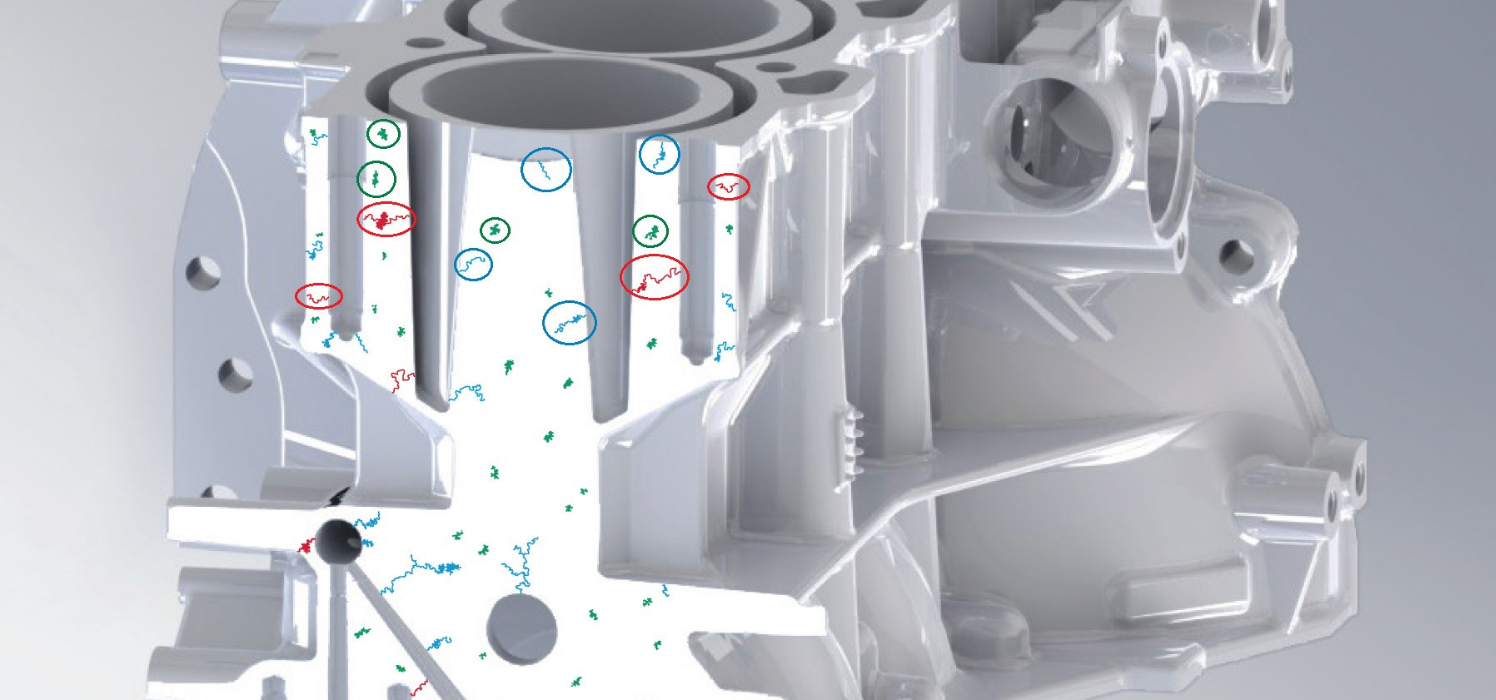
Figure 1: There are three types of casting porosity: blind porosity, through porosity, and fully enclosed porosity.
Blind and through porosity cause immediate casting problems. Blind porosity can cause internal corrosion; while through porosity will create a leak path and allow gas and liquids to seep through the casting (Figure 2). In addition, blind porosity can cause defects on the part surface when secondary treatments, like powder coating or anodizing, are done. This is because solutions used to clean the castings prior to the treatment will leech out of the voids after the surface finish process.
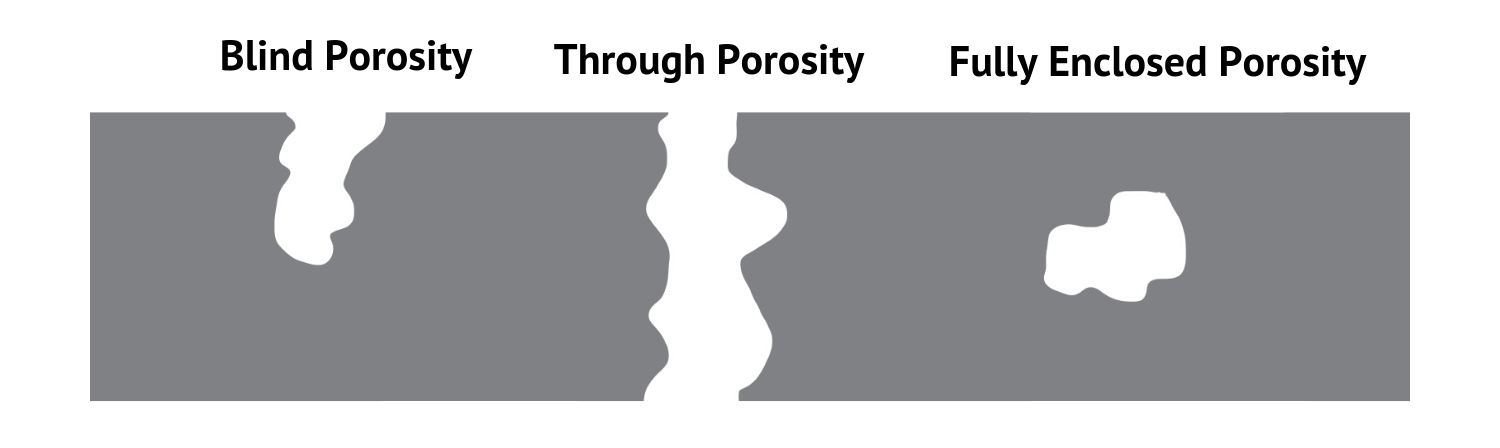
Figure 2: Blind porosity can cause internal corrosion; while through porosity will create a leak path and allow gas and liquids to seep through the casting.
When a machine tool cuts into the surface or “skin” of a casting, it can expose or open porosity (Figure 3). The porosity may be either blind porosity or existing blind and enclosed porosity may be opened and become through porosity.
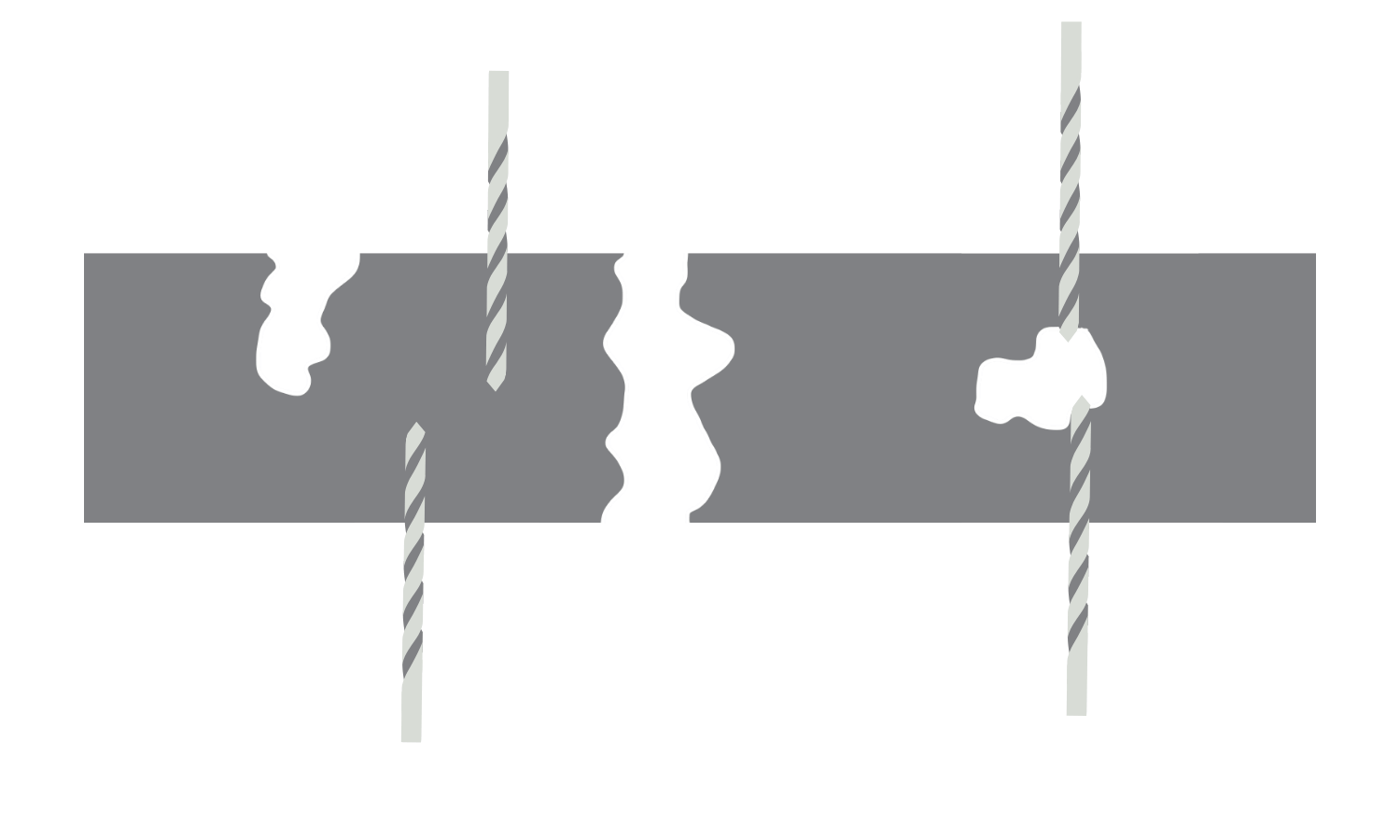
Figure 3: When a machine tool cuts into the surface or “skin” of a casting, it can expose or open porosity.
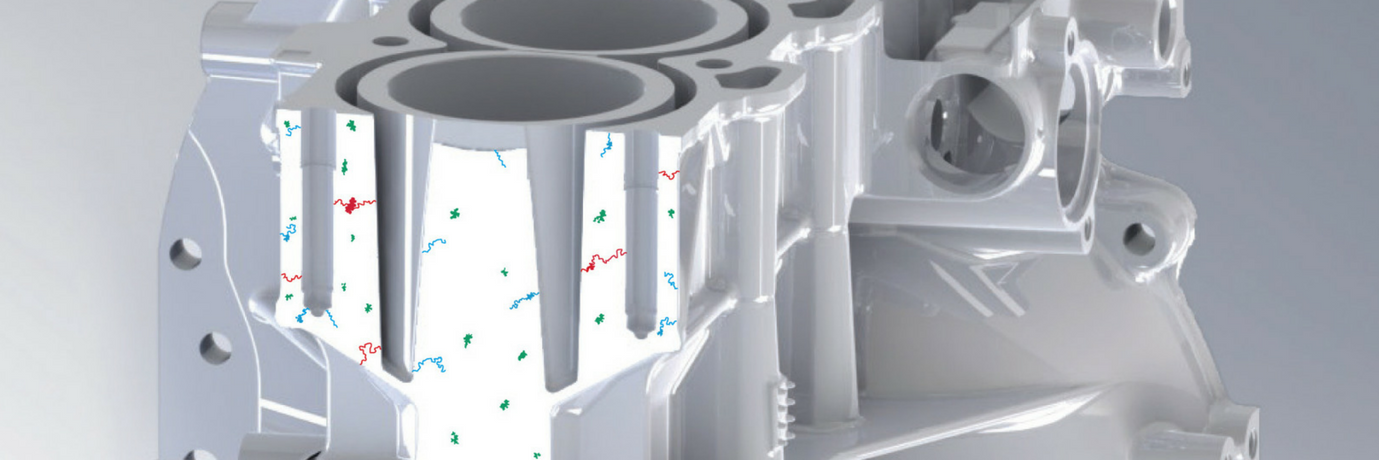
The new inter-connected porosity (highlighted in green) will create a leak path (Figure 4). The leak path will cause fluids and gases to leak from the casting, causing it to be non-conforming, and in many cases unusable. Unfortunately, this occurs precisely at the wrong time, since the non-conforming part has already been cast, cubed (pre-machined), washed, tested, shipped, fully machined, washed and tested again. All the value has been added to the non-conforming part. In the worst-case scenario if the problem occurs frequently, the manufacturer may have maxed-out their production and may be unable to replace the non-conforming castings with functional parts, delaying shipments and significantly increasing costs.
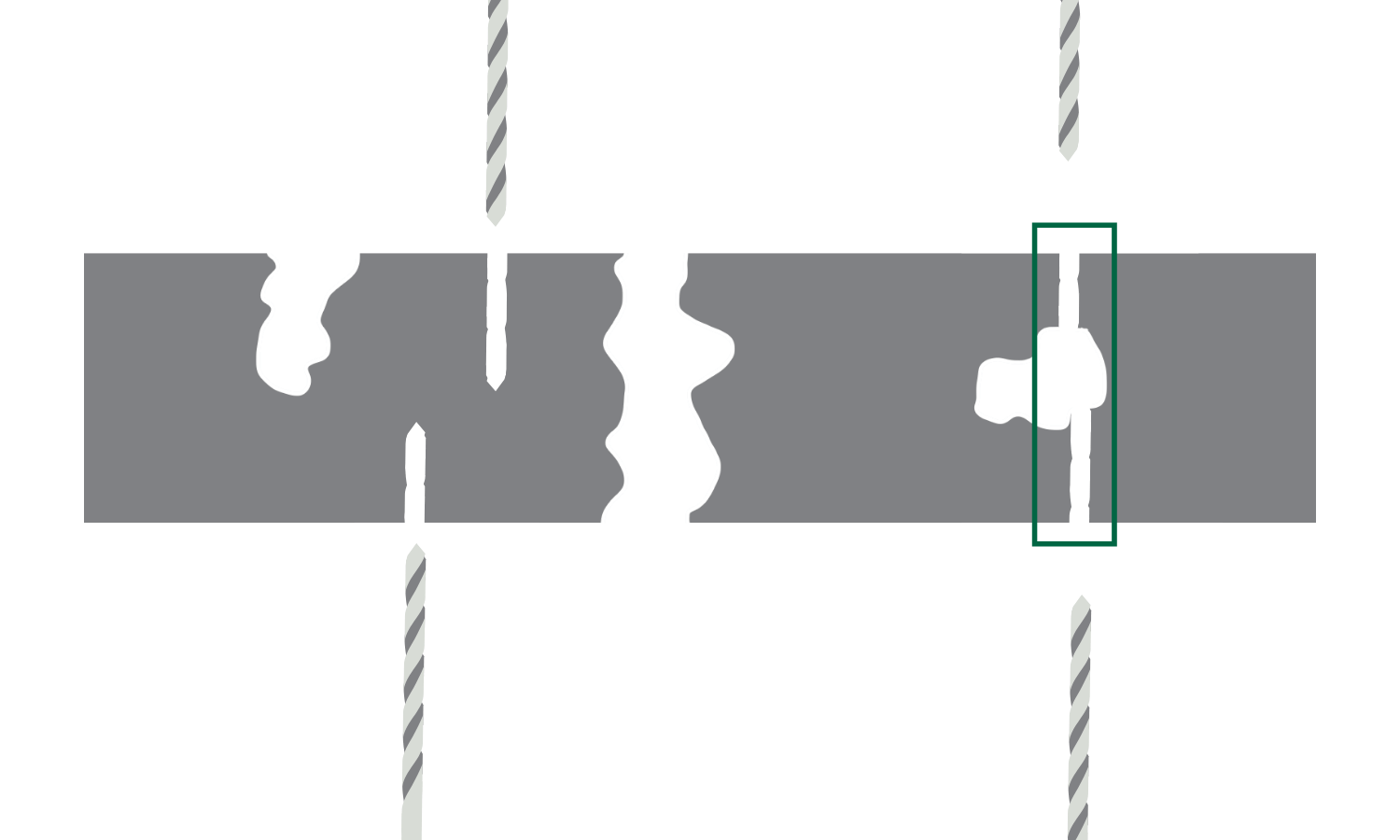
Figure 4: The new inter-connected porosity (highlighted in green) will create a leak path. This leak path will cause fluids and gases to leak from the casting, causing it to be non-conforming, and in many cases unusable.
Impregnating 100% of castings after final machining is the best way to insure leak free castings at build. If prior to assembly, a final leak test of individual parts is incorporated into production, leak testing fully machined casting and impregnating only the non-conforming parts (often referred to as fix-on-fail) is an excellent alternative.
Another approach is that manufacturers have chosen to increase the machining content at the pre-machine stage (cubing) thus maximizing the exposure of blind and through porosity prior to the parts reaching the final production line. After pre-machining 100% of all parts are impregnated and tested. Only conforming parts are sent through to production when the parts are fully machined in production only a reduced amount of material is removed. Since the impregnation at pre-machining has already sealed both the blind and through porosity, the opportunity to open an interconnected leak path is substantially reduced. In some cases, any non-conforming parts that make it to final test can be easily impregnated without disrupting production on a “fix-on-fail” basis.
Because machining may potentially uncover additional casting porosity, vacuum impregnation should be done after machining. Performing vacuum impregnation after machining is the only way to seal all leak paths. However, some castings may be pre-machined or cubed. Impregnating 100% of production castings after cubing will seal the exposed porosity. In this case, impregnation is still very effective in reducing non-conforming parts at final assembly.
It is the end of another year. Which means that it is time to address our mixed feelings about New Years
resolutions, and reflect on the year that is about to end. While we cannot help with your 2017 resolutions, we
can look back on the most read vacuum impregnation and porosity blogs of 2016. Here are our top 5 blogs from
2016.
When a porosity problem occurs, the first challenge
is to determine the type of porosity. The following
porosity classification guide can help you determine
the porosity type.
When a customer has a casting with porosity that is leaking,
they need a solution quickly. Here are some of the more common
questions that we receive in regards to vacuum impregnation and porosity.

Casting impregnation stops leaks caused by porosity.
It is important to understand what vacuum impregnation does not do.
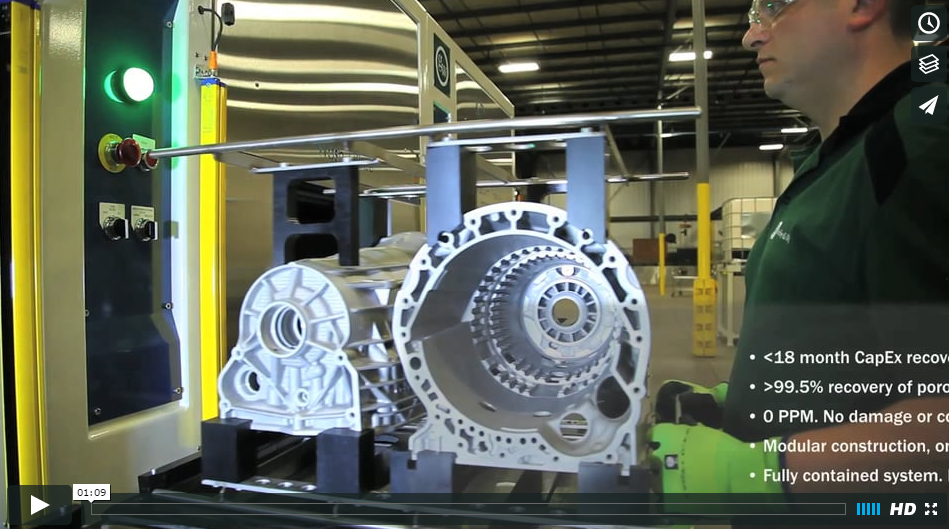
The Advanced Powertrain impregnation (APi) system simplifies
and compacts the vacuum impregnation process for parts like
engine blocks or powertrain transmission cases.
Next year, we will continue to write insightful and helpful content on vacuum impregnation and porosity. Don’t worry,
our 2017 blogs will not require gyms or special diets. They will help you understand vacuum impregnation and solve
your porosity problems.
From our team to your, Happy New Years.
When a casting porosity problem occurs, the first challenge is to determine the type of porosity. The following porosity classification guide can help you determine the porosity type. This is important information to know, because the type of porosity will dictate the vacuum impregnation process to use.
In general, there are three basic classifications of casting porosity:
Blind and Through porosity cause immediate casting problems. Blind porosity can cause internal corrosion; while Through porosity will allow gas and liquids to seep through the casting. In addition, blind porosity can cause defects on the part surface when secondary treatments, like powder coating or anodizing, are done. This is because solutions used to clean the castings prior to the treatment will leech out of the voids after the surface finish process.
Fully enclosed porosity is not a problem unless secondary machining uncovers this porosity. Machining can break fully enclosed porosity, which will then turn it to either Blind or Through porosity. This is important to know, because porosity detection should not be done until machining of the casting is complete.
Related: Should Vacuum Impregnation Be Done Before or After Machining?
The best way to seal Blind or Through porosity is with vacuum impregnation. Vacuum Impregnation eliminates the negative effects of porosity such as leaks, and corrosion, thus achieving completely sealed castings. Understanding the porosity and using vacuum impregnation will allow you to efficiently produce parts while minimizing costs.
Video: Understanding the Vacuum Impregnation Process
We are sometimes told by customers that they are unaware of what vacuum impregnation is. Ultimately, they have a casting with porosity that is leaking whatever is passing through the part (i.e. air, gas, water, etc.), and they need a solution to their problem. Here are some of the more common questions that we receive in regards to vacuum impregnation and porosity. Our intent is that you can use this information as a guide when you need to correct castings with porosity.
Would you like this information in a printable form? Of course! Click here to download it as a pdf.
What is porosity?
Porosity is an area of sponge-like texture in an otherwise sound metal casting. There are two types of porosity:
Porosity is typically caused during the casting process by internal shrinkage, gas cavitation, oxide films and inclusions and the many combinations thereof.
What is vacuum impregnation?
Vacuum impregnation (also known as “impregnation” and “impreg”) seals the porosity in metal castings, thus making leaky castings pressure tight.
What is the process of vacuum impregnation?
In a nutshell, the impregnation sealant is introduced into the voids within the wall thickness of the casting through vacuum and/or pressure methods. Subsequent processing solidifies the sealant.
What are the types of porosity?
There are three types of porosity:
How does impregnation improve product quality?
When casting porosity is reviewed during inspection, “good” castings are as porous as the “bad” castings because the porosity is blind and not completely inter-connected. Subsequent mechanical or thermal shock or stress often breaks the thin membrane in the “good castings” which keeps the blind porosity from being continuous, thus causing a “leaker”. Impregnation fills porosity from both sides preventing leaks even if the membrane does break. Therefore, impregnation salvages castings and improves quality, while inspection only sorts out leakers.
What materials can be impregnated?
All ferrous and non-ferrous metals, whether sand cast, gravity die, pressure die castings or forgings can be impregnated to eliminate porosity. Iron, bronze, aluminum, zinc, magnesium, steel, sintered metals and plastics, as well as alloys of these metals can be impregnated.
Can cracked castings be fixed through impregnation?
No. Impregnation will not increase the strength of a casting. The cracks will reopen when the casting is under pressure.
Can vacuum impregnation cure surface flaws?
No. This is because impregnation is within the part and not a surface treatment.
Should impregnation occur before or after machining?
Impregnation occurs after a casting is machined. This is because machining may potentially uncover additional porosity.
Will impregnation discolor or damage the casting?
No, because impregnation occurs within the walls of the casting. There is no film or coating on the part surface that will change any dimensional tolerances.
These are not the only questions we receive in regards to vacuum impregnation and porosity.
To discuss your specific questions, or situation, contact us at 330-562-1440 or send us an email.
Next Steps